Sharif Bey: Autoethnography
Opening Reception: February 12, 5 to 7 p.m.
February 12 - July 19, 2026


Alfred Ceramic Art Museum is delighted to announce the opening of “Autoethnography,” a solo exhibition by the groundbreaking artist Sharif Bey. The exhibition provides important examples from all of Bey’s central bodies of work – ranging from wheel-thrown vessels to intricate figurative sculptures, from gargantuan necklace forms to imposing ceramic shields – while highlighting in particular the transition between his functional pottery and figurative sculpture. Take the Virtual Tour!
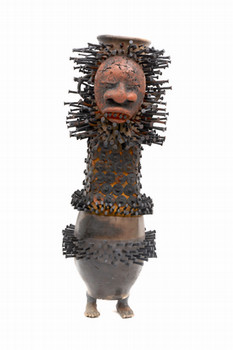 At the young age of ten Sharif Bey discovered, in the Carnegie Museum where he was enrolled in an after-school program, many of the ingredients that were to form the basis of his entire artistic practice. Wandering the museum, his encounters with both the bones of the natural history wing and the comprehensive collection of the art wing planted seeds that were to grow steadily throughout his life. Of particular note was his encounter with an nkisi n’kondi (or “power figure”) created by someone from the ancient Kongo peoples of central and west Africa, whose culture stretches back for millennia. Perhaps it was because it united the two wings of the museum, somehow appearing as both natural and cultural, as both the product of human agency and something radiating an otherworldly power, that it left such an impression.
This idea of objects as vessels of mysterious energy, as containers of spirit, ancestry and power remains tangible in Bey’s work today. In his book “All the Beauty in the World,” Patrick Bringly describes his own reaction to encountering an nkisi. He writes, “It wasn’t meant to look like a divine being; it was the divine being and, as such, had to appear as though it existed across a chasm from ordinary human efforts. It had to look a bit like a newborn baby looks: Not an imitation or depiction of anything, but rather a new, miraculous, self-insistent whole.” These words express very well the reaction one has after encountering Sharif Bey’s work for the first time. Here art is not an imitation of nature, or of anything else for that matter, but a genuine act of creation, bringing forth something radically new into the world. Whether in the figurative nkisi-like vessels, the “protest shields,” the gargantuan necklaces of his “Adornment” series, the monumental figures of the “Guardians” series, or his richly textured pottery, Bey endeavors to create touchstones of power.
At the same time, this sense of the sui generis nevertheless 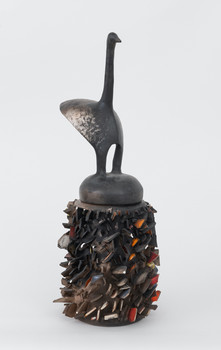 originates somewhere, and this is where the “autoethnography” of the exhibition’s title comes into play. Autoethnography goes beyond the linear history of autobiography to explore one’s connection to broader socio-cultural contexts, to bring to the surface the sometimes hidden and sometimes overt cultural forces that help make us who we are. In Bey’s own words, the question is not simply “Who am I?” but rather “Who am I in relation to who we are?” In his case this often involves understanding himself in the context of the past and present African diaspora, and much of his work directly engages with specific African and Afro-diasporic traditions. But his work also directly reflects his many other shifting cultural identities: As a former teenager from a large family in 1990’s Pittsburgh; as a devoted husband and father; as a highly-trained educator, and as someone deeply versed in American studio ceramic history who, from a young age, was fortunate enough to work with some of the most well-known ceramic artists of the time through the Manchester Craftsman’s Guild and summer workshops around the country.
Hence Bey’s varied work draws on many divergent sources simultaneously and suggests a deliberate tug-of-war of influences and interpretations, illustrating his interest in “how the meaning of icons and function transform across cultures and time.” After all, the nkisi figure Bey encountered in the Carnegie, for all its power, is also an icon of colonial violence, an artifact ripped from its original context and preserved under plexiglass for a colonial audience. At the same time, the Kongo figures that most closely resemble Bey’s work are in fact a form of nkisi n’kondi known as Mangaaka, which were made in the 19th century as a direct response to colonial violence. The nails and shards embedded in Bey’s work can easily be read as sources of violence and affliction, yet in the tradition from which they derive the nails were often embedded into a figure as an act of taking an oath, making a promise, or ensuring peace between rivals. The “beads” of the large necklace forms of the “Adornment” series were taken from the shapes of bones, bird-skulls or claws, shifting the aesthetic context not only in scale but also from the natural to the cultural. A functional vessel might suggest African patterns but also reveal the influence of David MacDonald and Winnie-Owens Hart (whom he has described as important mentors) or other well-known American ceramicists like Val Cushing, Robert Turner, Norm Schulman or Ed Eberle.
At a time when “identity politics” continues to dominate contemporary discourse, and many artists turn to their own identities as sources of inspiration, Sharif Bey’s work goes beyond the solipsism of autobiography to reveal a brilliant ethnographic process that situates the individual rightly in a complex sea of cultural forces.
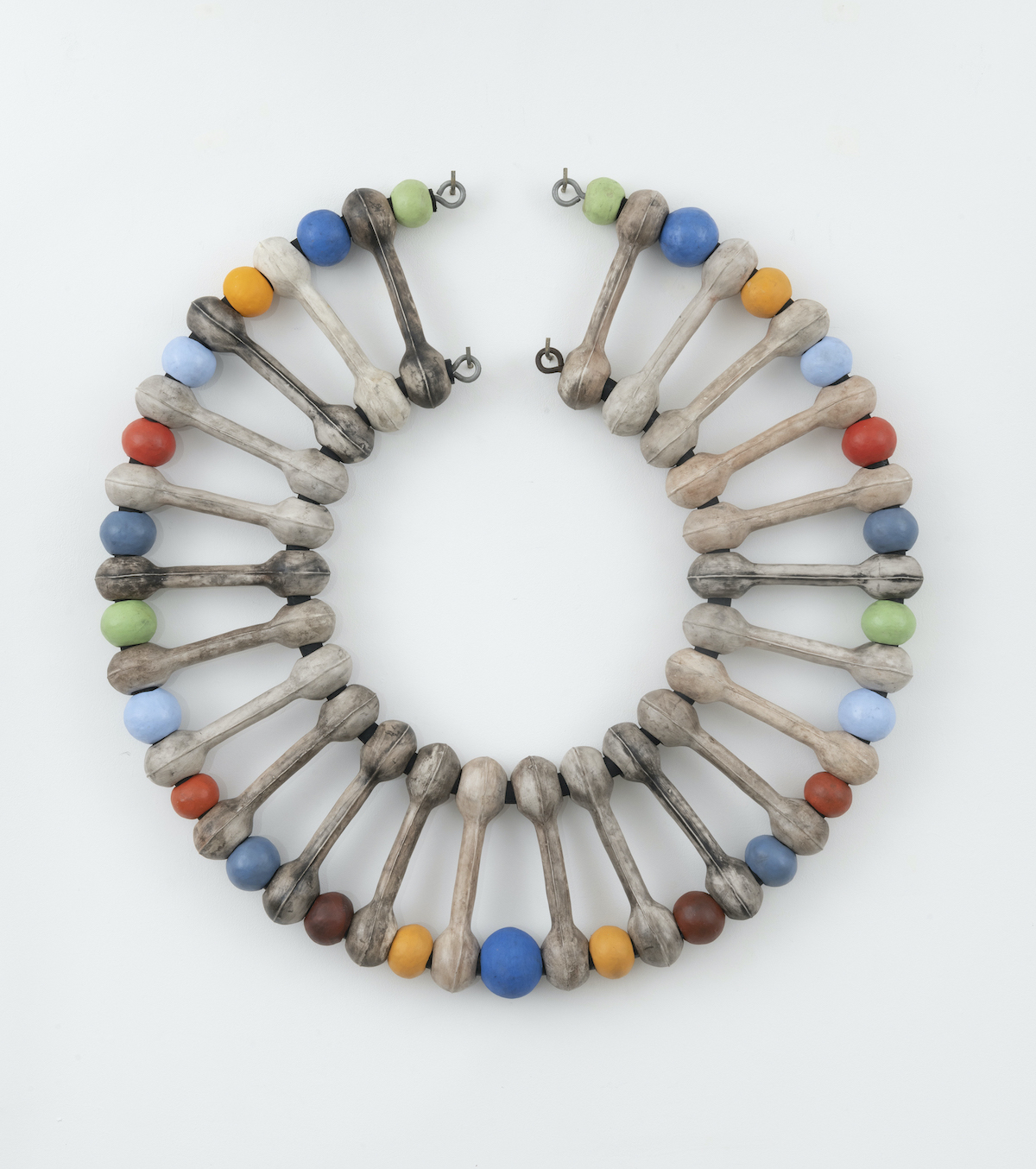
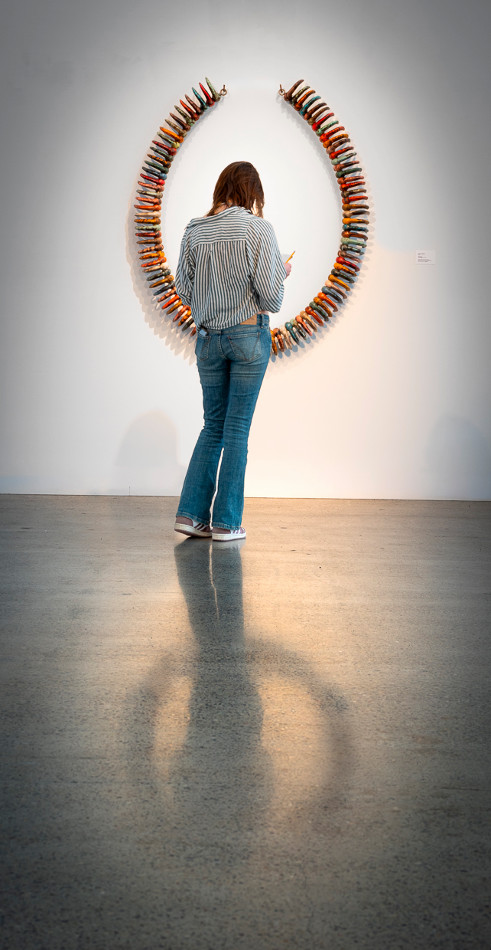
Images from top: Yardagain, 2021; Ceremonial Vessel, 2022; Louie Bones, 2021; Raptor Rougher II, 2021. All images courtesy of the artist and albertz benda, New York and Los Angeles.