Figure Out: Catastrophe or Regeneration
Paolo Porelli
September 10 - December 20, 2026
Opening Reception September 10, 5 to 7 p.m.
Alfred Ceramic Art Museum is delighted to announce the exhibition “Figure Out: Catastrophe or Regeneration” by Paolo Porelli.
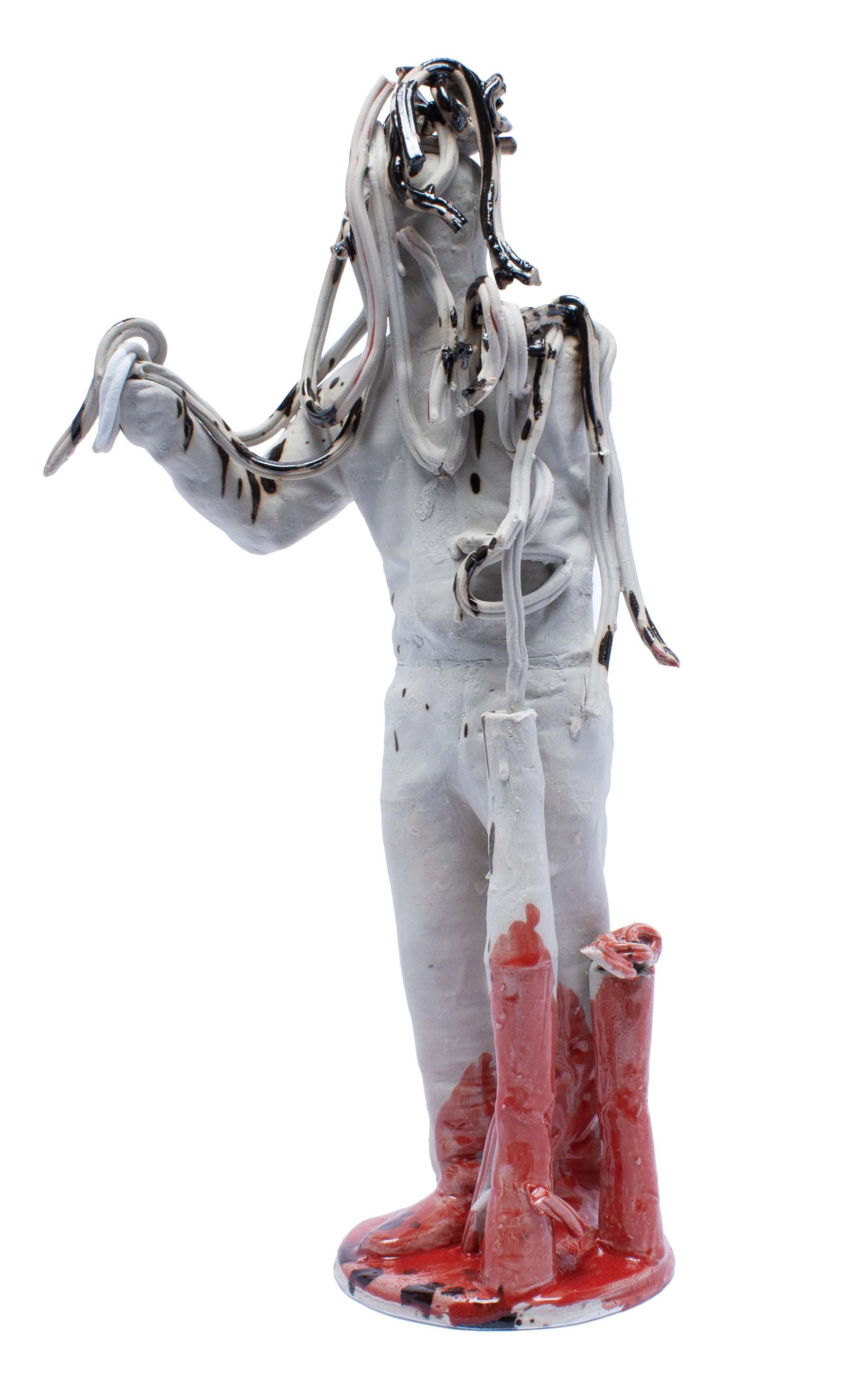
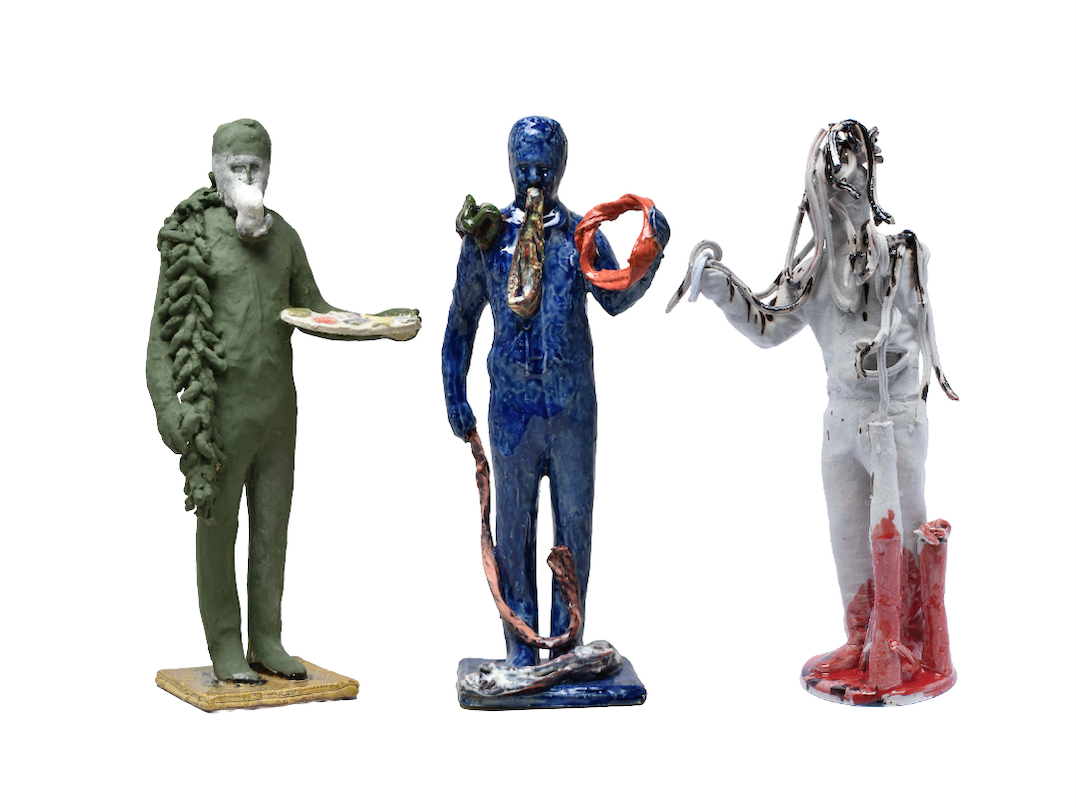
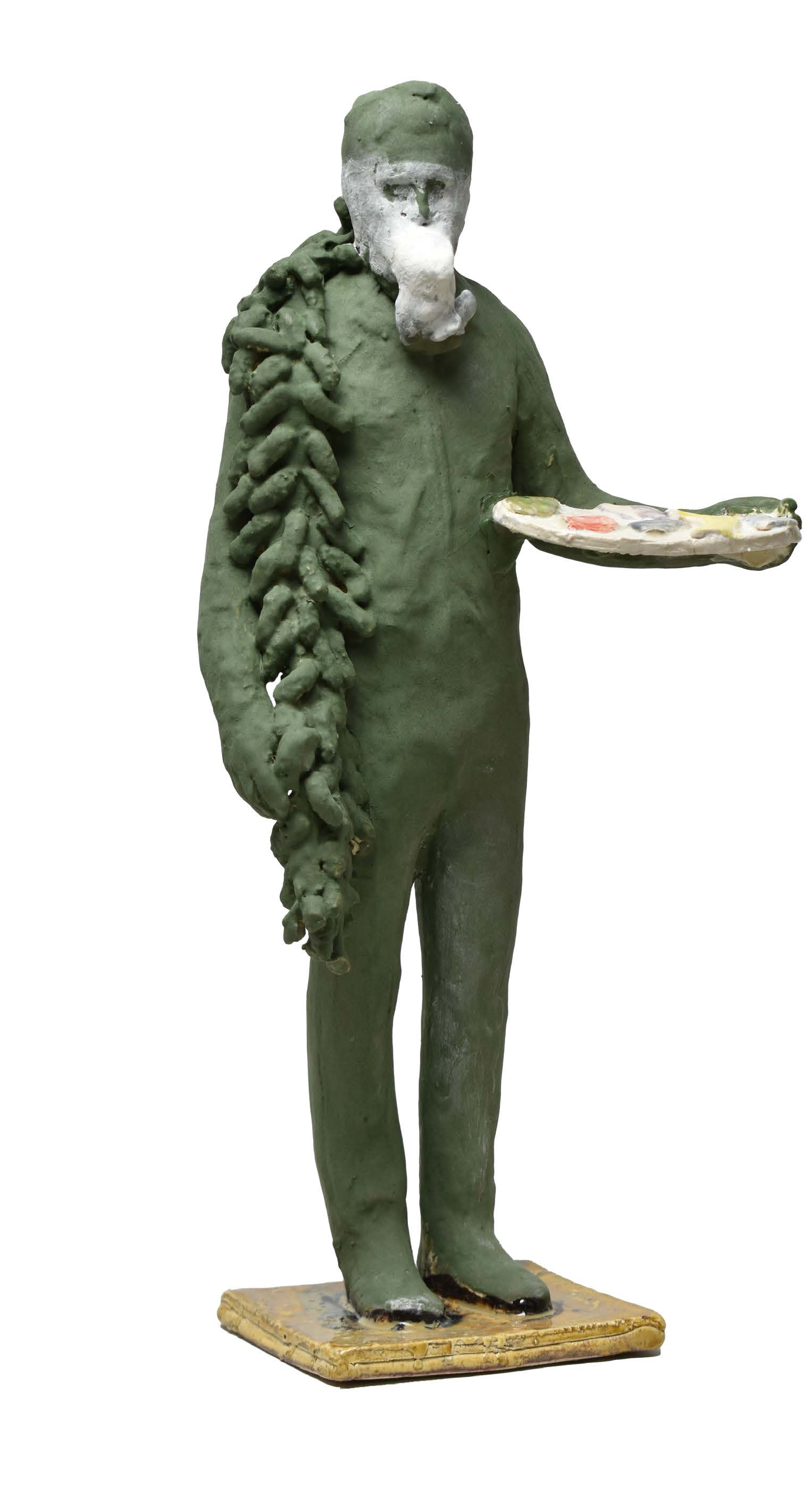
The centerpiece of this exhibition showcases 60 statuettes of wildly diverse and idiosyncratic characters sparked by strange intuitions and a fervent imagination. Some have faces entirely obscured by sausages or mops or flowers. Some appear to wear unorthodox scuba gear or magic hats. Some carry thunderbolts or mirrors or mysterious orbs. Some appear to be slowly dissolving, or perhaps evolving, like either cemetery statues being covered in moss or futuristic humans developing radical mutations. Their titles hint at their occupations and range from the ordinary to the bizarre. We meet shepherds, musicians, and flower sellers, but also smokers, radioactive workers, magicians, and mutants. In each case we are given a definite persona, a character from an unwritten myth.
An Italian based in Rome, his partner in both art and life is the art historian Lori-Anne Touchette, who specializes in classical Greek and Roman art. It comes as no surprise, therefore, that his work draws on and elaborates figurative forms in the tradition of classical Italian statuary. Also very much present are styles and tropes found in ancient Greek and Roman mythology: the gods and goddesses, heroes and villains, monsters and marvels that populated the ancient stories that gave meaning to their world. For decades Porelli has developed a dizzying collection of eclectic, surreal figures that invite us to inhabit a contemporary mythology whose stories have not yet been told.
 This body of work was developed over two residency periods, the first at Arch Contemporary in Tiverton, Rhode Island in 2019 and 2020, and the second at the Clay Studio in Philadelphia in 2022. Porelli sees the work in “Figure Out: Catastrophe or Regeneration” as a way of turning his mythological menagerie towards the current ecological moment, which he views as one of both Catastrophe and Regeneration. He describes the features of his figures — some loaded with symbols of consumption, production and excess while others laden with more organic, natural and fertile forms — as reflective of this moment. Will regenerative forces overcome the powers leading us to catastrophe? Or is collapse inevitable at this point?
Alternatively, we can view catastrophe and regeneration as constantly conjoined phenomena. Perhaps Porelli’s creations are the beings that will come into existence in the wake of catastrophe, the regenerating mutants that have emerged from the rubble our civilization left behind? However they are read, as harbingers of hope or doom, or as fantasies of a postapocalyptic future, or as souvenirs from an ancient lost realm, perhaps the most important gift Porelli’s work gives us is hope in the power of the human imagination, the sense that mythmaking stretches deep into the past but also far into the future.
The pieces are all slip cast from a small number of molds, but then altered individually to create the diversity of characters on display. This method bears resemblance to the way in which mass-market toys like G.I Joes, Barbies or figures from the Star Wars or Marvel Universe franchises are made: Quite generic men and women are given different costumes, hairstyles, weapons and equipment to create distinctive heroic and villainous identities. They also share a common scale with the current vogue for “limited edition” collectables of comic book characters, and their names often ring a bell with “Malibu Barbie” or “Jedi Knight.” However, the connection with pop-culture fantasy worlds, seemingly omnipresent today, goes further than this. Traditionally such worlds enforce a Manichean separation of the universe into forces of good and evil (though more contemporary projects delight in endlessly blurring these once firm boundaries). As mentioned, Porelli describes this work in similar terms of opposing constructive and destructive forces, but it is not always obvious from the figures themselves who is who or what their roles might be. This is more in keeping with the decidedly anti-Manichean world of Greek and later Roman myth, in which gods and goddesses were neither good nor evil but rather capricious and very human-like entities to be feared and placated rather than emulated as models of virtue. In the face of polarizing opposite forces, or perhaps even because of such forces, Porelli has given us a world in which ambiguity rules the day and absurdity is an inevitable result of attempts to deal with it all. In this light, the work goes beyond the ecological crisis Porelli originally had in mind and can be seen as tangentially addressing the contemporary world’s tendency towards polarization in general.
BLACK ICONOLOGY:
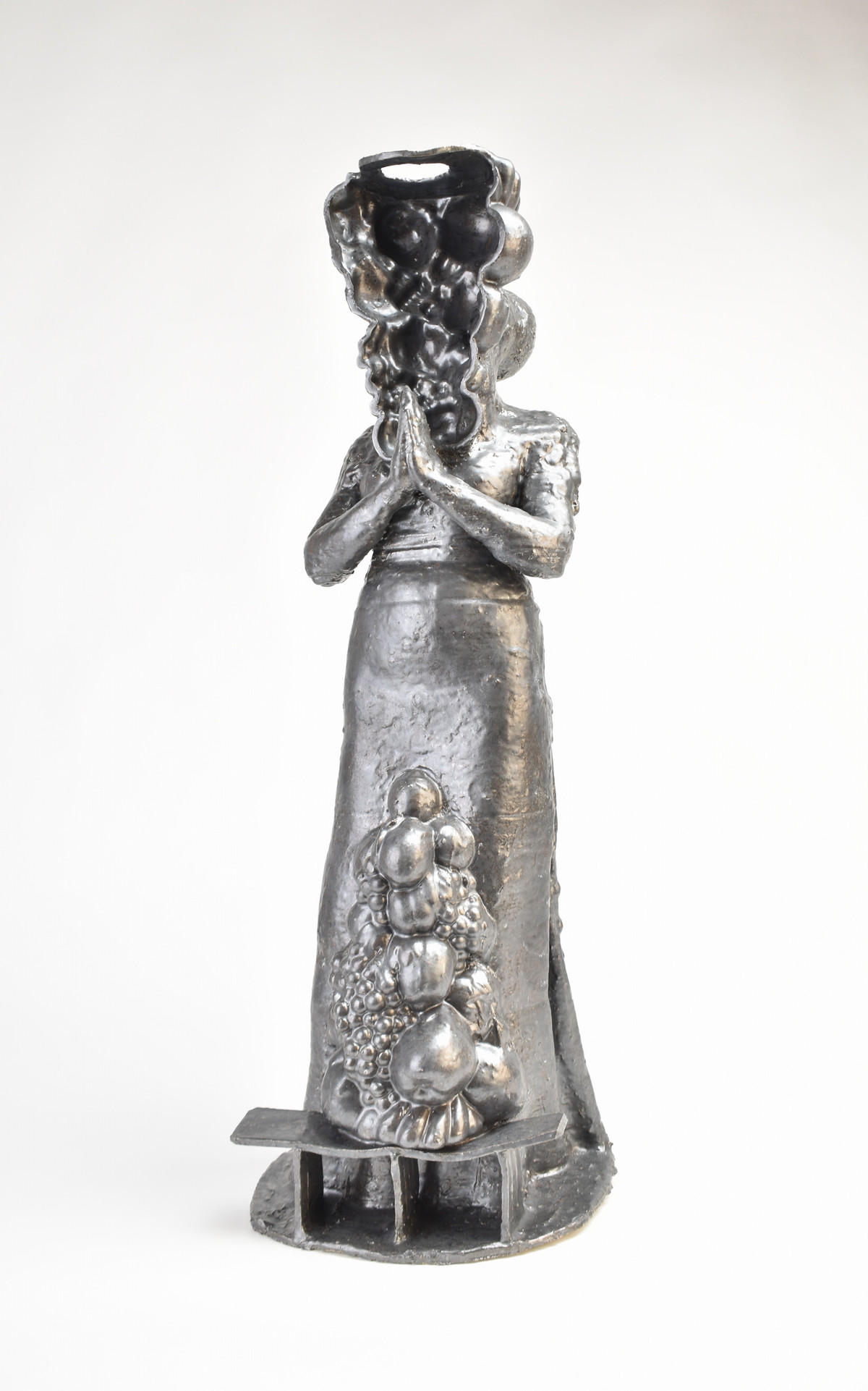 The exhibition also includes the debut of Porelli’s most recent series “Black Iconology.” Much larger and more visually homogenous than the others, these figures reveal Porelli’s delight in and mastery of his materials. His glaze gives the work the appearance of metal, somewhere between a shimmering silver and a heavy lead. They too seem to occupy a position between growth and decay, as though discovered in an Atlantean shipwreck but then polished back into life. Yet the figures here are even more complex, and take on an altar-worthy gravitas, as reflected by some of their titles: Confucius, Minerva, Penelope.
This increased gravitas is largely the result of Porelli’s increasingly refined techniques with his materials. The works in Figure Out might come across as elaborate, home-made toys from an invented parallel universe. These new works, often at least double in size, rich in textured detail and glistening in a precious metal shimmer, do not get put away in the toybox. They belong in quasi-sacral niches, in guarded cloisters, and in dark vaults only to be brought out for mysterious semi-annual rituals. Though not divinities to be worshipped, they nevertheless would be at home amongst the religious paraphernalia through which we explore our contemporary ideas of the supernatural, as though looted from a postmodern temple of tinfoil. Collectively they form an excellent counterbalance to the perceived whimsy of Porelli’s other work.
About Paolo Porelli
After graduating from the Academia di Belle Arti di Roma with a degree in painting, Porelli gravitated toward ceramics and began experimenting with the figures for which he has become well known. Since 2002 he has had dozens of solo and group exhibitions in Europe, the United States and China, as well as participating in numerous residencies throughout the world, including at the Archie Bray in Montana, the Clay Studio in Philadelphia, and the Blanc de Chine Award residency in Jingdezhen, China. In 2012 he and his partner Lori-Anne founded the international residency program CRETA in the historical center of Rome with the aim of serving as a “point of encounter for international exchange between artists, collectors, donors and the public” In 2021, he was elected a member of the International Academy of Ceramics.