Eugene Ofori Agyei: Fihankra (You Did Not Say Goodbye When You Left Home)
Opening Reception: February 12, 5-7pm
February 12 - July 19, 2026


Eugene Ofori Agyei arrived at Alfred University in 2023, chosen by the Division of Ceramic Art faculty as the Turner Teaching Fellow in the School of Art & Design at the New York State College of Ceramics. Over the course of the following years, he formed a bond with the students, faculty and entire community, all the while developing his own unique practice. Take the Virtual Tour!
 The exhibition consists of a body of work made during this period, and will be shown for the first time. The sculptures begin with the creation, in clay, of a large Adinkra symbol atop a solid support. Adinkra are a visual system of signs from the Akan ethnic group of Agyei’s homeland of Ghana, in which a single symbol can encapsulate a complex proverb, philosophical idea, or moral teaching. An example can be found in the title of the exhibition, which can be expressed by the symbol on the right. It can be interpreted as a call for those dispossessed by colonialism to return home (captured slaves had no opportunity to say goodbye), but maintains a certain ambiguity for the contemporary diaspora who might maintain connections to multiple “homes” and thus have no need to say goodbye. More simply, it can also be taken as a symbol of the security found in solidarity, literally representing a safely enclosed house.
 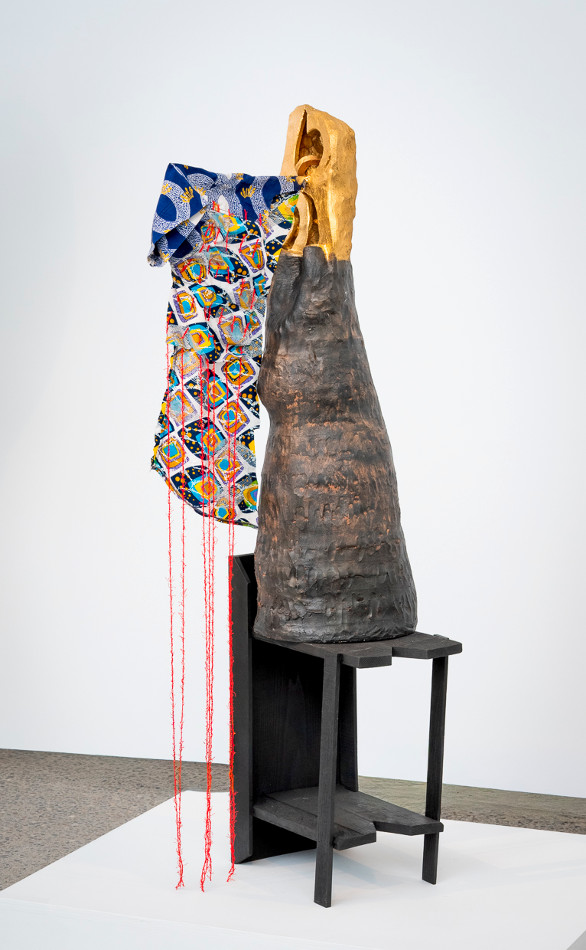 Agyei then brings these layered symbols together with wooden benches of the type common from his youth, symbols of community and tradition, but also of play, as they were sometimes used as structures for hide-and-seek games in his childhood. The bench forms are often inverted or balanced on end to support the ceramic works, and these elements are then further transformed through the incorporation of colorful batik fabric, yarn and occasional found objects (a watch, some shin pads, a tire) to create highly original mixed-media assemblages. Often the foundational symbol remains clearly visible, but sometimes it is rendered illegible in the creative process, suggesting that the goal is not a literal translation but rather a way of recontextualizing and re-activating the sign. This effacement perhaps hints at a sense of loss, that an idea can mutate, deform and become lost in translation, but also that new contexts present new creative possibilities.
This fragmentary, mixed-media approach is a deliberate choice Agyei uses to reflect the oftenfragmented, assembled nature of African diasporic identity. For Agyei the works function as metaphors for the struggle to maintain a coherent identity from so many disparate and ever-changing parts. Coherence in both art and in life is presented as a balancing act, bound together with twine, sometimes messy and on the verge of falling apart, sometimes carefully cultivated and sometimes filled with tension, supported only by a single red thread. 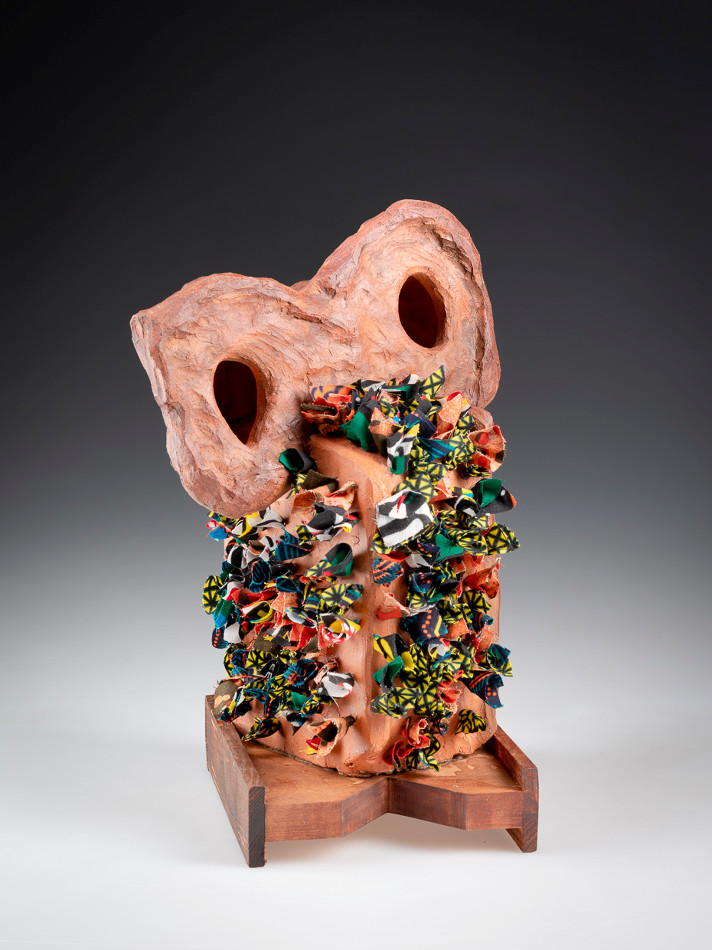 The assembled, improvised, yet carefully crafted nature of the work reflects Agyei’s own complex personal history. Originally born into a family in the Akan ethnic group, as a boy he moved into an Ewe community following his parents’ divorce, which created a nacent sense of being an outsider. This feeling followed him when, as an adult, he moved to Togo. There the distinction between his earlier ethnic identities broke down, and he became simply “Ghanaian.” This mutation of identity went further still in 2020 when he moved to Florida for graduate school, as even the specificity of “Ghanaian” gave way to the simple blanket category of “African” (and the even more complicated notion of being “black”). Adaptation to shifting cultural boundaries are key themes in this work, and the tensions of this process are clear. Nowhere is this more apparent than in the video works premiering in this exhibition: In one of which the artist literally tears his hair out. Yet equally apparent is the sense of a willful, even joyful act of self-creation from the materials one finds to hand. Agyei’s work reveals a wonderful sense of delight—in color, in texture, in sheer materiality, and in the creative act itself. If the works are intended as metaphors of diasporic identity, they are not somber, academic meditations on loss, but rather playful experiments of possibility.
Agyei holds a degree in Industrial Art from Kwame Nkrumah University of Science and Technology in Kumasi, Ghana, and an MFA in Ceramics from the University of Florida. He has been awarded two NCECA fellowships, an Artaxis fellowship and the 2022 Pathways Carlos Malamud Prize. His sculptures have appeared in group exhibitions across the United States, at the American Museum of Ceramic Art, the Black History Museum and Cultural Center of Virginia, and the Utah Museum of Contemporary Art, among others. Solo shows have taken him to the Rollins Museum of Art in Florida, North Dakota State University and Die Neue Sammlung (The Design Museum in Munich). He is currently Assistant Professor of Art at Knox College in Galesburg, Illinois.
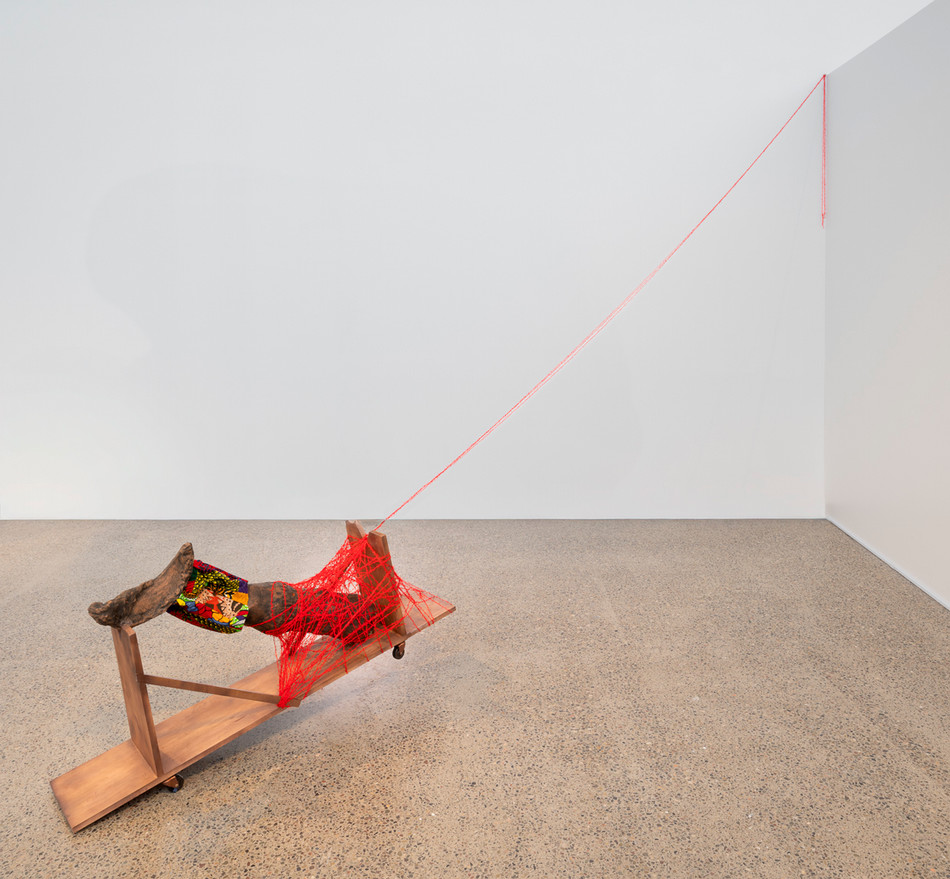
The exhibition will be accompanied by the 2026 Perkins Lecture in April, which will feature a conversation between the artist and independent curator Larry Ossei-Mensah, who also has Ghanaian roots. Ossei-Mensah has curated exhibitions on four continents, worked with a host of leading artists, and is also a co-founder of ARTNOIR, a nonprofit supporting artists and curators of color. View the 2026 Perkins Lecture.
Works from top to bottom:
- Gold Head, 2025. Earthenware, underglaze, batik fabric, yarn, wood.
- Kro Kro Me, 2025. Earthenware, underglaze, batik fabric, wood.
- Caught in the Web, 2025. Earthenware, underglaze, batik fabric, yarn, wood, found objects.
- Photography by Brian Oglesbee.