Paula Murray: Resilience
September 10 - December 20, 2026
Opening Reception: September 10, 5 to 7 p.m.
Alfred Ceramic Art Museum announces the exhibition “Resilience,” featuring work by Canadian artist Paula Murray.
Paula Murray’s work is unapologetically beautiful and unafraid to take on some of the most difficult and universal issues of human experience: Breaking and healing, transformation, the search for truth of different kinds, and finding pathways towards reconciliation.
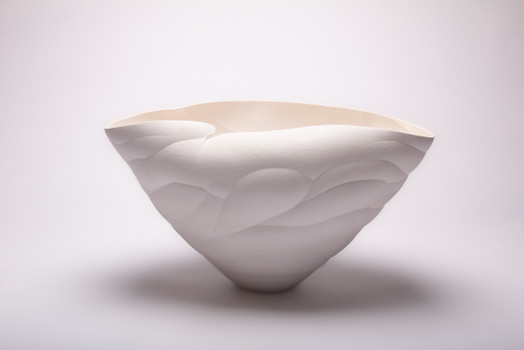
The work on display can be seen as operating at multiple levels simultaneously, revealing connections between nature, body, spirit, and the social world in which we live. Pieces such as Remnant #2 (2007), Rolling with the Tide (2004), Ebb and Flow (2024), and others emulate natural processes like the curling of drying leaves, the forming of shells, the fracturing of bark, or the movement of waves. Murray’s work reminds us that nothing is static, that growth, transformation and decay are distinctive elements of the natural world. Nature provides the example of resilience through cyclical patterns of rupture and recovery.
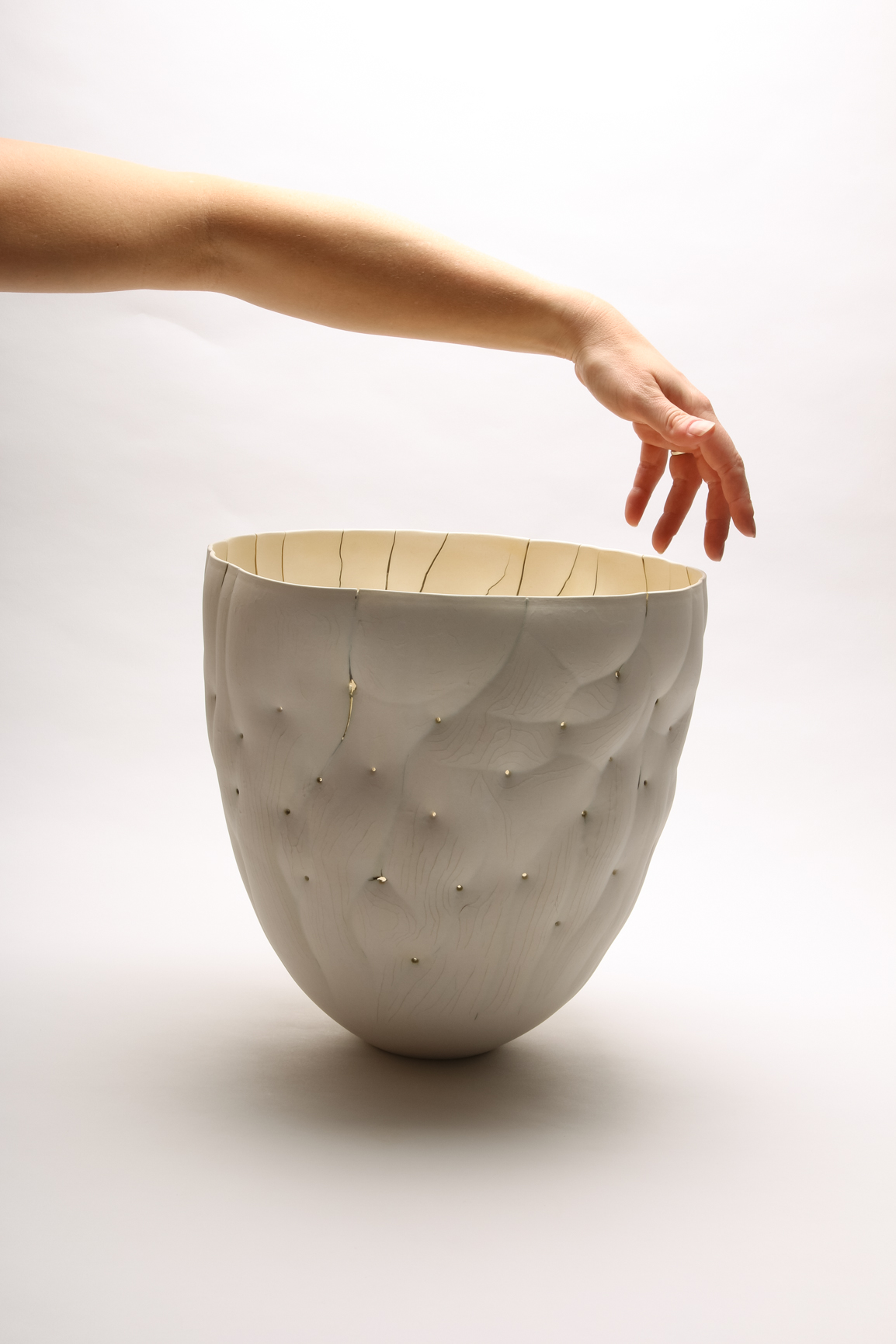
Many pieces can also be read as placeholders for human bodies, such as Respire II (2023), Abundance (2024), or A Way Out (2004). Her vessels often suggest muscle, fat, or wrinkled skin, and emphasize differences between internal and external surfaces: Undulating exteriors hide a fractured interior. As bodies, this cracking of the porcelain can be read as so many scars, the traces of physical injury and aging. Yet bodily injury is itself a metaphor for emotional wounding, and perhaps the tearing of social fabrics as well. Fractures, injuries and wounds are presented as requisite parts of being human, reminders that breakage and recovery are not only part of a fundamental dialectic of human experience, but also the very source of growth and change.
With works functioning simultaneously as 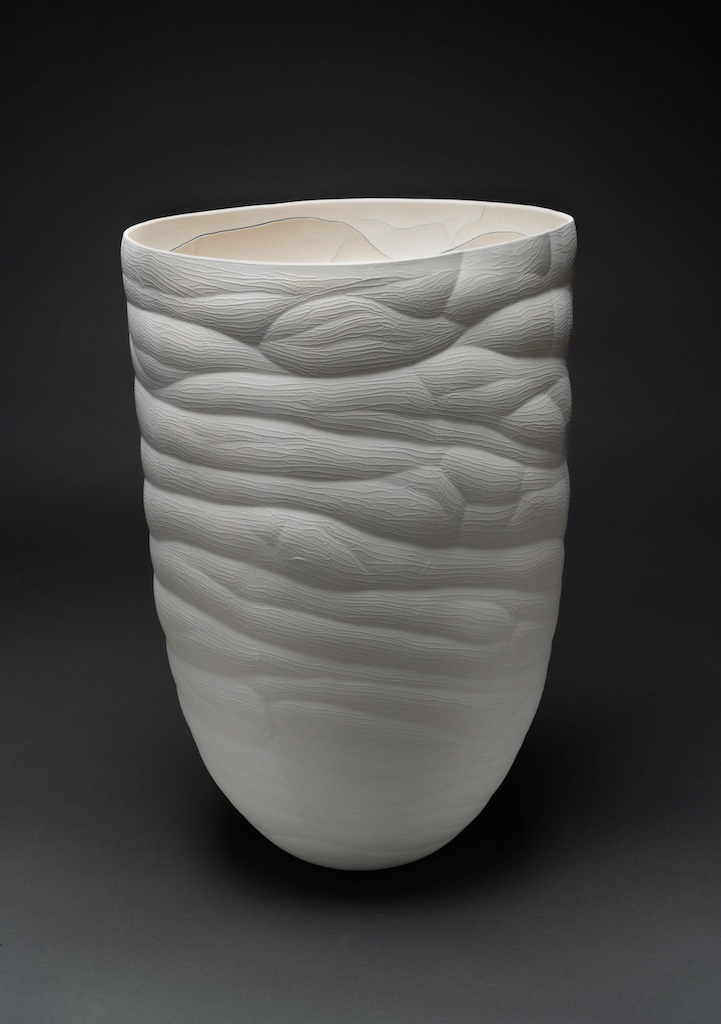 metaphors of nature and body we understand that these concepts are inexorably interconnected. The resilience of nature becomes a model for human beings, and we are reminded that humans are, whatever else they may be, at core natural phenomena. The French philosopher Maurice Merleau-Ponty used the memorable phrase “the flesh of the world” to suggest that the distinction between subjective experience and an objective world outside of us is a false one, that we are inextricably intertwined with the world we inhabit. Many of Murray’s works suggest themselves as something very like this, a fleshy world of cracking skin, somewhere between subjects and objects.
Transformation is also at the heart of spiritual practice. Murray is a practicing Baha’i, a faith tradition which stresses the fundamental unity of human beings and the importance of individual truth-seeking, and her work often reflects this practice. In Accumulation (2026), an installation created specifically for this exhibition, we encounter a pile of “scrolls” either falling from above or rising from the earth, each bearing a resemblance to wood and embedded with a tiny script of cracks caused by inducing stress while pieces are drying. The quantity of scrolls suggests the diversity of possible paths to follow, while the structure at the base can be read as a nest, or a dam, or simply as a pile of twigs. Meanwhile, Murray’s cracked vessels also reflect a spiritual journey and become meditations on human longing for the possibility of the divine. The oft-quoted saying from the Persian poet and philosopher Rumi that “the wound is the place where the Light enters you,” is sure to come to mind, but the context of this expression is worth remembering. Rumi was not simply pointing cheerfully at the silver linings of clouds, but describing the Sufi notion of suluk, the path of annihilation and return. His encounter with and subsequent loss of Shams Tabrizi utterly shattered his comfortable world, his entire sense of himself. This wounding is what lead to his transformation into a Sufi mystic and one of the world’s most read poets even 800 years after his death. Embracing the painful ruptures of life is part of the unfolding of spiritual wisdom, the movement from the material to the immaterial. One of the most moving articulations of these ideas is her vessel-installation Moving Towards the Light (2014), which can be viewed as a movement from either direction.
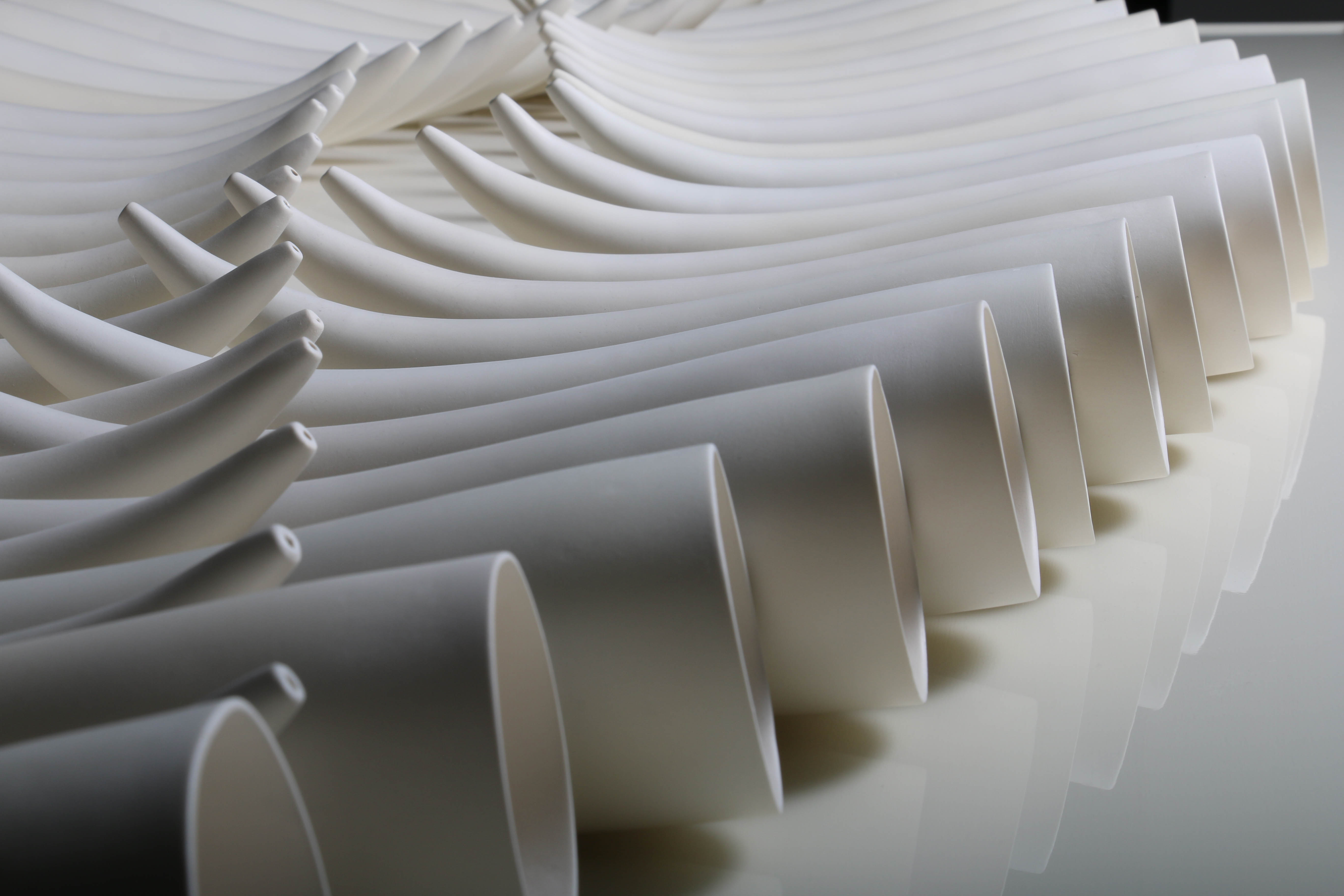
Yet Murray’s practice is not the solipsism of a private spiritual journey. Works such as Drops of One Ocean (2026), Peace Study (2026), and Who is Speaking? Who is Listening? (2019) are equally concerned with a broader context of the individual in a fractured world. The latter piece was created following her time as an artist-in-residence with the Canada C3 Expedition, a voyage on a ship in the high arctic with Canadians from all walks of life. The trip was organized to celebrate Canada’s 150th anniversary, but also to stimulate conversation about indigenous reconciliation, inclusion, diversity and climate change. The porcelain elements, which resemble ear horns but also perhaps the ribs of buffalo slaughtered to make bone China, suggest, in the artist’s own words, “a wave of equal components moving together, apart, then together again on level ground.” Similarly, Drops of One Ocean takes the simple bowl form and uses it to suggest the diversity and beauty of elements that can come from a single mold, and the integration of these individuals into a common fabric. It is worth noting that the installation comprises 95 bowls, a number with spiritual significance in the Bahá’í devotional practice, adding another layer of meaning to the work’s meditation on unity and diversity..
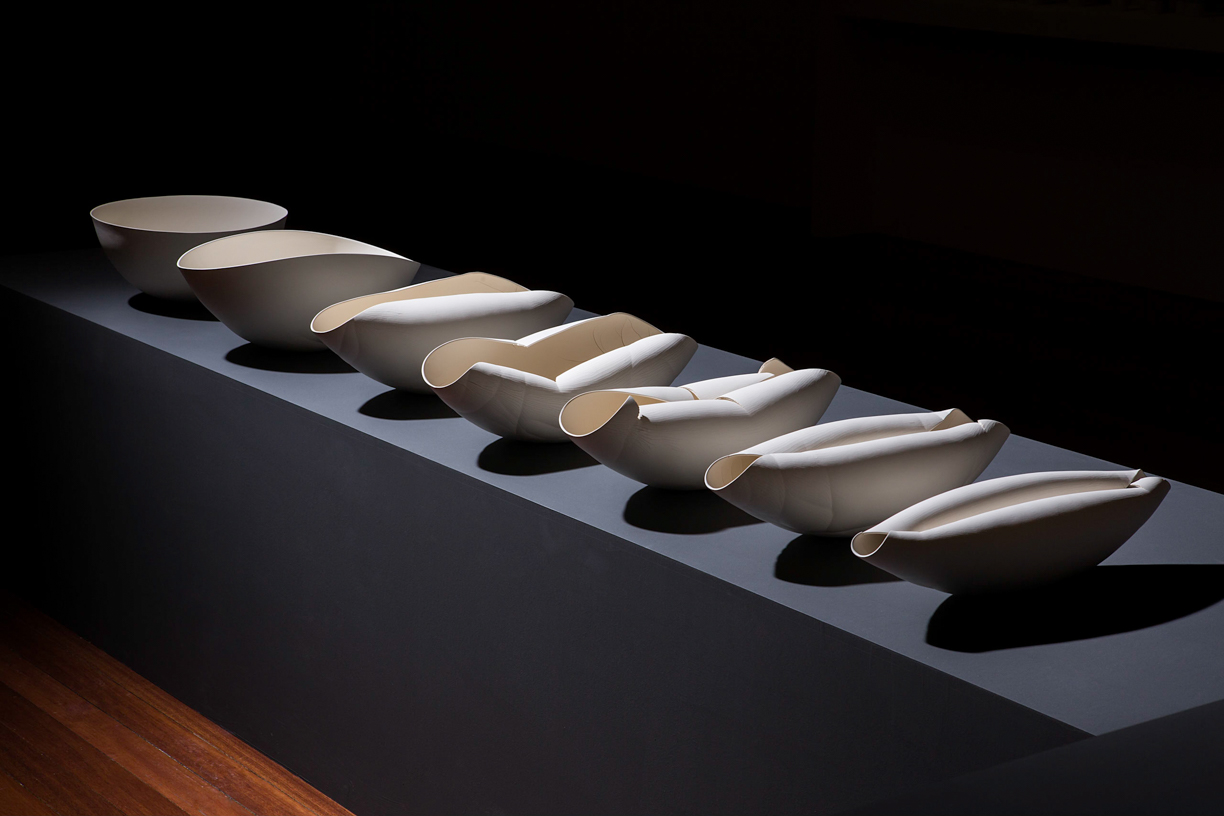
Holding these difficult themes together is the aesthetic experience of beauty itself, mysterious and still unexplained. Beauty can be a minefield for contemporary artists, particularly ceramic artists who wish to avoid what ceramicist Leopold Foulem derisively called the “beauty pageant system” of ceramics, in which “decorative and beautiful” are too often taken to be synonymous with “good and significant.” Yet beauty cannot be so easily banished, and is deeply relevant in Murray’s work. Beauty is at once a natural phenomenon, a sensual, precognitive experience of the body, an indirect hint at the possibility of ourselves as spiritual beings, and a core of our inter-subjective experience in communities. This beauty is not in service of the “cute commodity” so loathed by Foulem, but articulated as a fundamental experience of ourselves as natural, embodied, and even spiritual entities. Arguably, beauty here functions as itself a kind of wounding, a stabbing interruption of ordinary life, inviting the possibility of transformative experience.
Collectively, her work provides a space for both sensual experience and quiet contemplation of some of the biggest issues we, all of us together, face as human beings.
About Paula Murray
Born in Ottawa, Paula Murray studied science at the University of Ottawa and ceramics at Sheridan College. Living and working on the shores of Meech Lake, Québec since 1980, her life has been enriched by several years living on the water, sailing with her young family between Canada and South America. This ongoing relationship with the sea and the elements has intensified her appreciation of the ephemeral nature of our presence. Her long time interest in the nature of reality has been informed by her discovery and study of The Baha’i Faith.
Elected into the International Academy of Ceramics in 2017 and the Royal Canadian Academy of the Arts in 2006, she exhibits internationally, having received honourable mentions for prestigious competitions in China, Italy, Korea, Taiwan and Japan. In 2015 she was awarded the Prix du Conseil des arts et des lettres du Québec for Work of the Year for her installation Connection x Connexion and Artist of the Year for the Outaouais region. Selected collections include Korean Ceramic Foundation Museum, New Taipei City Yingge Ceramic Museum, Museum of Ceramics, Faenza Italy, Canada House, London, UK, and in Canada the Gardiner Museum, Museum of History, City of Ottawa, the Canada Council Art Bank and The Canadian Clay and Glass Gallery.
"Paula Murray has….opted for a path that lies out along porcelain’s very fringes. She’s pushed the material’s tensile qualities way past their literal and figurative breaking points and in the end created work of enormous beauty, power, and meaning. It all has to do with a willingness to abandon (or at least, put aside) the aesthetic fundamentalism of a purist approach.” -- Gil McElroy 2007