History: A Legacy in Motion
Alfred Ceramic Art 1900-2025
May 08 - December 14, 2025
Opening Reception: May 8, 5 to 7 p.m.
One hundred and twenty-five years ago Charles Fergus Binns was invited to become the first director of a new initiative at Alfred University, the New York State School of Clay-Working and Ceramics. Binns was a skillful potter with an established practice at the Royal Worcester Porcelain Works, and had a talent for drawing gifted people to him. It is no exaggeration to say that he, along with his initial core of instructors, launched American studio ceramics, and at the same time transformed Alfred into a hub of creative ceramic activity that has persisted to this day. The students of this school went on to become celebrated instructors of their own right, launching ceramics programs across the country. Eventually the art and engineering of ceramics were recognized as distinct disciplines, though Alfred remained a celebrated destination of study for both. Over the years, the school of art grew to include new disciplines to reflect the changing landscape of American art, but ceramic practices remained at its core. The next generations of instructors solidified the Alfred reputation through their unique contributions, such that no book on the history of American ceramics can be written without mention of the Alfred legacy.
Today the Alfred Ceramic Art Museum is delighted to present the history (and legacy) of this ceramic tradition by showcasing the work of 26 artists who taught or continue to teach in this unique community. In so doing, the exhibition highlights a key chapter in the history of American ceramics, a story of art but also of industry, craft, aesthetics, politics and increasing diversity. Works on display include functional and aesthetically rich vessels by early pioneers, innovative forms by some of the country’s most well-known figures, and contemporary work that push the boundaries of possibility and continue Alfred’s legacy of excellence.
Exhibiting artists include: Charles F. BINNS, Marion FOSDICK, Charles HARDER, Don SCHRECKENGOST, Daniel RHODES, Ted RANDALL, Val CUSHING, Robert TURNER, Wallace HIGGINS, William PARRY, Wayne HIGBY, Tony HEPBURN, Tom SPLETH, Anne CURRIER, John GILL, Andrea GILL, Doug JECK, Walter MCCONNELL, Linda SIKORA, Matt KELLEHER, Linda SORMIN, Yonatan HOPP, Jason GREEN, Stephanie HANES, Paul BRIGGS, and Nicki GREEN.
History: A Legacy in Motion is co-curated by ACAM Director Wayne Higby and Assistant Director Benjamin Evans.
Virtual Tour
The wonders of modern technology now allow us to present the entire exhibition to you from the comfort of your own screen. Whether you live far away, simply missed the show, or would like to see it again, here is your opportunity to explore this important record of ceramic education in Alfred.
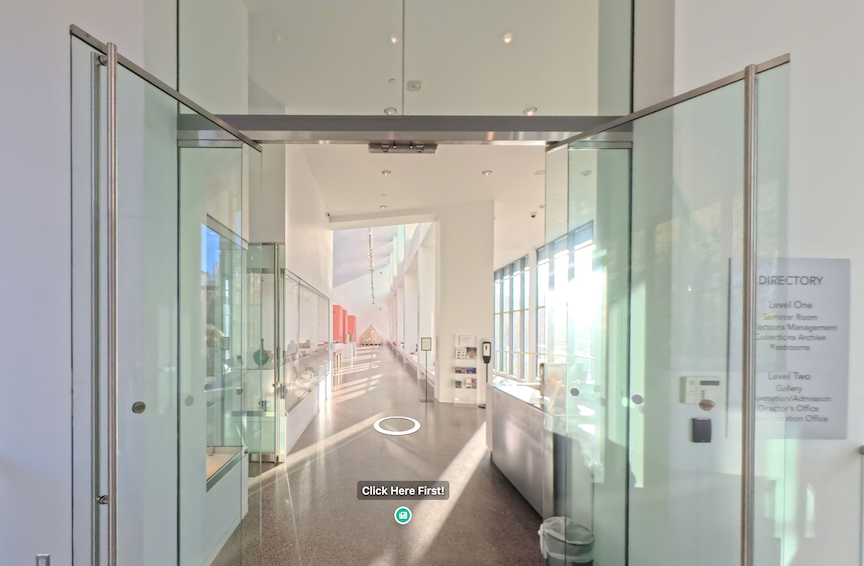 Take the Virtual Tour
Gallery Talks
Towards the end of the exhibition, we were lucky enough to have ten of the participating artists come to the museum for a series of "Gallery Talks" about their work and the legacy of Alfred. These presentations provided Alfred students and the general public with unprecedented access to some of the people who have made, and continue to make, Alfred the place that it is.
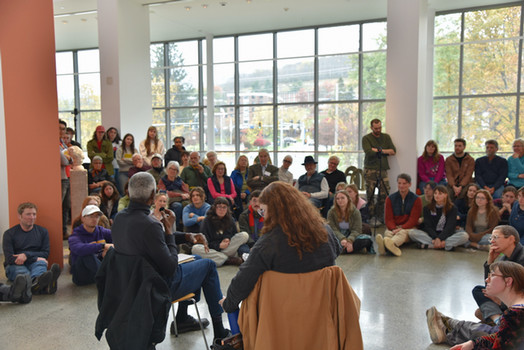
Access the Gallery Talks
The Red Clay Rambler Podcast
Just before the close of the exhibition, The Red Clay Rambler Ben Carson sat down with co-curators Wayne Higby and Benjamin Evans to talk about the exhibition and Alfred's legacy. The conversation covers key figures from history like Binns and Harder, but also rambles around the curation of the show and all the wonderful information that came to light as a result of it.
Listen to the Podcast
Artist Biographies
Years at Alfred: 1900 – 1931
Charles Fergus Binns was the first director of the New York School of Clay-Working and Ceramics at Alfred University, the school that was to become today’s New York State College of Ceramics (NYSCC). His thirty-one years at the college left a lasting impact on the American tradition of ceramics, and he has been referred to as “the father of American studio ceramics” by art historian Margaret Carney. Originally from Worcester, England, Binns was the son of the director of the Royal Worcester Porcelain Works, and studied ceramics, art and chemistry in Worcester and Birmingham. During his time working at his father’s factory he also developed a reputation as a scholar and lecturer, and when he moved to America in his early forties (October 1897), he lectured and consulted along the East Coast until he was hired as the new director for the Alfred initiative. The program was unique at the time in offering an education in both ceramic art and technology, which flourished under his leadership. Binns’s own studio practice focused on utilitarian forms emphasizing the importance of aesthetic qualities, and as a result played a significant role in the American Arts and Crafts Movement. His book, The Potter’s Craft, was both popular and influential when it was published in 1910. In addition to his emphasis on strictly controlled techniques, perhaps Binns’s most significant contribution lies in the number of people he trained who themselves went on to influence American ceramics, people like R. Guy Cowan, Arthur Baggs, Fredrick Walrath, Maija Grotell, Elizabeth Overbeck and Adelaide Robineau, among others.
Years at Alfred: 1921 – 1953
Marion Fosdick arrived in Alfred in 1915 to teach design and painting, having graduated from the School of the Museum of Fine Arts in Boston and the Kunstgewerbe Museumschule in Berlin. However, she began studying ceramics with Binns in 1919 and was teaching modelling and pottery by 1921. As evidence of her prodigious talent, by 1926 she was awarded the first “Binns Medal” by the American Ceramic Society for her outstanding work, and in 1931 was named as a fellow of the same organization. Along with Clara Katherine Nelson, who was hired to teach painting and drawing after Fosdick’s shift to ceramics, she played a central role in developing the design curriculum in the early days of the college. She began with an industry-needs survey in the mid 1920s, and then worked with Charles Harder and Nelson to develop the Ceramic Art curriculum throughout the 1930s, oversaw its transformation into Industrial Ceramic Design (from 1939–1951), and on into a more Bauhaus-inspired Ceramic Design (1951–1965). Her long career at Alfred contains many highlights worthy of note: Her work was collected by the Metropolitan Museum of Art; she contributed to Adelaide Alsop Robineau’s journal “Keramic Studio;” she won the Everson Ceramic Nationals competition in 1941; she exhibited at the New York World’s Fair of 1939. Students remember her in hallowed words as a very kind instructor who knew how to give crucial feedback without hurting feelings, and as a peerless craftsperson. In 1950 she was awarded an Honorary Doctorate by Alfred University, and today her legacy lives on in the form of the Fosdick-Nelson Gallery at the NYSCC.
Years at Alfred: 1927 – 1957
Charles Harder enjoyed a thirty-year career at Alfred, during which time the NYSCC underwent many critical changes. Harder was invited by Charles Binns to come to Alfred as an instructor in 1927, and was promoted to Assistant Professor in 1931. He took a sabbatical in 1935 surveying curricula, courses and administration of other art schools, and also spent time with practicing designers in the ceramic industry. By 1944 he was the Chair of the Design Department. Harder had been to Chicago to study László Moholy- Nagy’s “New Bauhaus” aesthetic, and as a result brought to Alfred a committed pursuit of “functional design.” Respected historian of ceramics Elaine Levin refers to the notion of an “Alfred/Harder/ Bauhaus tradition,” as if those ideas were essentially synonymous. Harder continued Binns’s emphasis on technical production and materials mastery rather than individual expression, though his respect for more “expressive” artists is evidenced by the fact that he brought influential ceramist Samuel Haile to Alfred for a year as a visiting instructor. Harder was also a well-respected designer and maker in his own right and served as a consultant for several production companies and designers, including the Enfield Pottery & Tile Company, the Empire Crafts Corporation, Southern Potteries and R. H. Macy Company in New York, among others. Today Alfred’s Harder Hall serves as a reminder of his legacy.
Years at Alfred: 1935 – 1945
Don Schreckengost was born in Sebring, Ohio, a key site of industrial ceramic production at the time. Ceramics was a family business, as his father managed the kilns at a local company and brought home material for his children to model. Even before graduating from high school, he and his older brother Paul learned techniques of model and mold-making at the Gem Clay Forming Company. Perhaps as a result, his two older brothers, Paul and Victor, also went on to careers in ceramics, with the eldest Victor achieving a lasting nationwide reputation. In 1935 Don graduated from what is now the Cleveland Institute of Art, during which time he made a much-admired dinnerware line known as Tricorn while working as an intern at Salem China. Very soon afterwards he was hired at Alfred as both a professor and the chair of design department, where he was given a mandate to develop the industrial design curriculum. In 1945 he left Alfred to become the Director of Design at the Homer Laughlin China Company in West Virginia, the largest pottery in the world at that time. There he created several popular designs which further cemented his reputation. In 1960 he established his own company, Don Schreckengost Design for Industry. This long career has led him to be credited as the first American industrial ceramic designer. He was awarded the Binns Medal by the American Ceramic Society in 1946 and made a fellow of the organization in 1950.
Years at Alfred: 1947 – 1974
Like several of the ceramicists who helped to define the Alfred legacy, Daniel Rhodes started his career as a painter, concentrating particularly on murals. However, in 1941-42 he attended the NYSCC, studying under Charles Harder and visiting instructor Sam Haile, and was the first to graduate with from the newly created MFA program in 1943. He worked for the locally-owned Glidden Pottery for a short period, and then moved into industrial ceramic research in California. For his war effort he taught ceramics at a Japanese internment camp, Heart Mountain. There he met Minnie Negoro, and brought her back with him to Alfred when he returned to take up a teaching position at Alfred in 1947, a post he held for almost 30 years. Rhodes, like many, was much influenced by Bernard Leach’s 1940 A Potter’s Book, but also by the painters of the emerging movement of Abstract Expressionism, which lead to a looser, more experimental approach to his ceramics, often involving overlapping elements, splashes, drips and loosely applied glazes. Partly in response to Leach, he published Clay and Glazes for the Potter in 1957, which served as an important modern update on the earlier works of both Binns and Leach and became essential reading for any aspiring ceramicist. It was so popular it was reprinted in 1973, and a revised edition was published in 2000. He continued to publish books on ceramics throughout his life, and was awarded a medal by NCECA for his contribution to teaching in the field.
Years at Alfred: 1951 – 1981
Ted Randall was another long-term member of the Alfred community who left an indelible mark not only on the institution but on multiple generations of aspiring artists. Randall already had a career as an artist prior to coming to Alfred, working from a sculpture studio in Brooklyn before joining the army during World War II. He came to Alfred as a graduate student shortly thereafter and then stayed on as a both a professor and administrator. He made functional vessels, but also sculptures and hybrid forms he referred to as “sculpots.” He continued Alfred’s reputation as a place which emphasized a balance between technical precision and artistic expression, exploring modernist ideas in ceramics and arguing for the inclusion of ceramics as a “fine art.” In his early days at Alfred he made some of the work for which he is best known, but his production decreased as his administrative responsibilities grew. Later, when returning to his practice after retiring, his work took on a more sculptural dimension which often recalled ancient Chinese bronze forms. Yet it was in no small part through his administrative role that he left a major mark on Alfred and the wider American ceramics community. It was during Randall’s tenure, taking over from Harder, that Alfred fully expanded from its emphasis on ceramics to become a multi-disciplinary art school with degrees available in most arts disciplines. Randall was also the primary force behind the establishment of NCECA as an independent organization whose focus would be on both artists and educators. He is also known for his development of an innovative, modular, and affordable kick wheel which can still be found in studios today. He is remembered at Alfred through the “International Randall Chair,” a position for international artists and scholars to spend a semester teaching at Alfred.
Years at Alfred: 1957 – 1997
Val Cushing was, and remains, one of Alfred’s most well-known graduates. Earning both his BFA and MFA degrees from the NYSCC, he joined the faculty in 1957 and stayed for forty years. Cushing is particularly well known for his summer school workshops, which drew potters from across the country, as well as for workshops he gave around the world. His work follows the Alfred tradition of balancing technical skill and the pursuit of aesthetic experience, though in describing his work himself the emphasis is on the beauty he found in nature: “I aspire to make beautiful pottery — some to be used and some to function visually, as sculpture. I look for ideas in a variety of places, but nature is my primary source. It is in nature that I find the rich colors, the dynamic textures and the harmonious forms I love to make.” He is known for his rich natural glazes, particularly autumnal reds and browns. In a short interview prepared for NCECA, Cushing also talks about the influence of jazz and the importance of diversity and improvisation in his practice. With a single weight of clay, he would produce many variations, with carvings or decorations or manipulations of shape creating eclectic forms from the same fundamental source. He also stressed the importance of evolution over longer periods of time, noting how his work slowly developed over the course of his career. Cushing’s self-published “Handbook” continues to be a crucial resource for contemporary potters, with ACAM continually receiving new orders for it from all over the country.
Years at Alfred: 1958 – 1979
Robert Turner had an auspicious start to his ceramics career, one that foreshadowed the many awards and accolades he was to earn throughout his lifetime. During his freshman year at the NYSCC Turner had a small work accepted in the Ceramic National Exhibition in Syracuse and won honorable mention in the same event the following year. He graduated from Alfred with an MFA in 1949, and, after a short period establishing a pottery program at Black Mountain College, he returned to Alfred where he built a successful independent studio practice, being named “Potter of the Year” by the Philadelphia Art Alliance in 1953. He started teaching at Alfred in 1958, by which time he was already influential and well respected for his classic functional vessel forms. Throughout the 1960’s, however, his work took a more experimental turn and he transformed, according to biographers at the Smithsonian, into “one of the leading makers of organically abstract ‘art’ pots during the 1970s.” Travels in Nigeria and Ghana in the early 1970’s had a substantial impact on his practice, and he became increasingly interested in the spiritual role art could play in daily experience. A lifelong Quaker, and greatly influenced by the social and political upheavals in the country during this period, the question of the role of art in society was never far from his thoughts. At this point in his career his color palette diminished, and he began sandblasting his work to produce soft and inviting surfaces. He retired from Alfred as Professor Emeritus in 1979, and is remembered today by the Robert C. Turner Teaching Fellowship in Ceramic Art and the Turner Gallery in Harder Hall.
Years at Alfred: 1961 – 1985
Wallace Higgins had an early start to his career, serving in the air force as one of the famed “Tuskagee Airmen” in the Pacific Theatre during World War II before even graduating from high school. After returning from the war, he completed his BFA degree from the NYSCC in 1952, and went to work for Glidden Pottery in Alfred until its closure in 1957. He was then hired at Alfred as a technician, before becoming an associate professor in industrial design. In addition to his expertise in mold-making and industrial design, clocks and clockworks were of particular interest to Higgins, and he designed several in multiple media, frequently making ingenious use of materials from the area. His ingenuity can further be documented by the work he did with various students over the years on the power system for an electric car, a prototype of which involved a converted 1965 Volkswagon Beetle. He retired in 1985 as professor emeritus. He was known as a popular teacher on campus, and as a very active community member, working with the Lions Club, the fire department, the Allegany Senior Foundation, the Bakers Bridge Historical Society, and the Union University Church. In 2015 he was inducted into the New York State Senate’s Veterans’ Hall of Fame.
Years at Alfred: 1963 – 1989
William Parry was born at the close of the First World War and came of age just in time to serve in the second. Like his colleague Wally Higgins, when the fighting ended he returned to the United States and completed his studies at the NYSCC. He started out as a ceramics engineering major but later switched to studio arts, graduating with a BFA in 1947. He began his teaching career with a post at the Philadelphia College of Art, and returned to Alfred as an instructor in 1963, a teaching career spanning forty years. Notably, he was the first President of the NCECA, the organization he helped form with his colleague Ted Randall and others. Parry had a more experimental practice than some of his colleagues, making abstract, slab-built sculptures with unusual brushed-on glazes, and working in multiple media simultaneously. In a tribute written after his passing his colleague Val Cushing made special mention of “his belief and passion for living the life of an artist and teacher,” noting that he won the Kruson Award for Distinguished Teaching in 1991. In addition to his teaching career, Parry exhibited nationally and his work has been widely collected.
Years at Alfred: 1973 to present
Wayne Higby grew up in Colorado. He received his BFA from the University of Colorado in 1966 and his MFA from the University Michigan in 1968. His work reflects his initial study as a painter, using ceramic vessels, tiles, or sculptural objects as sites to create powerful landscape images. He is additionally well-known for his inventive use of earthenware Raku and porcelain techniques, and for his large-scale tile installations SkyWell Falls and EarthCloud. Since 1991 he has spent considerable time traveling, collaborating and teaching in China. In 2004 he became the first foreign national to be acclaimed an Honorary Citizen of the “porcelain city” of Jingdezhen. His diverse body of work developed over a lengthy career has earned him many accolades and awards, the most recent of which is the prestigious Smithsonian Visionary Award to be officially conferred in 2026 during ceremonies associated with the 250th anniversary of the US. Higby is a member of honor of NCECA, a Life Trustee of the Haystack Mountain School of Crafts, and an emeritus member of the International Academy of Ceramics, Geneva, having served on the Council of Directors for 20 years. His work can be found in many museum collections including the Metropolitan Museum of Art, the National Art Museum of China in Beijing, the Hermitage Art Museum in St Petersburg, Russia and the Museum of Modern Art, Tokyo. He has been the Director and Principal Curator of the Alfred Ceramic Art Museum at Alfred University since 2014. Higby’s retrospective was held at the Smithsonian American Art Museum and documented in the hardcover book Infinite Place: The Ceramic Art of Wayne Higby.
Years at Alfred: 1976 – 1992
Tony Hepburn was born in England, where he studied design at Camberwell College of Art and later at London University, where he earned his teaching credentials in 1965. He began visiting the United States in 1968, and in 1970 he taught a summer session at Greenwich House Pottery during which his roommate was Joseph Kosuth. At the time Kosuth was developing his conceptual practice that came to be known as “Art and Language,” and would prove to be an important influence on Hepburn. By 1975 he had regular stateside teaching positions, and took up a full-time teaching position at Alfred in 1976. Here he was influenced by the work of his colleague Robert Turner, who he regarded as one of the finest living artists, and about whom he went on to co-author a monograph. In his ceramic art he enjoyed working with elements of ordinary life, particularly tools and objects of the rural life around Alfred, such things as watering cans, mallets, funnels or even old boots. However, his work also continued in a notably conceptual direction, particularly in the larger structures he referred to as “Gates,” which he often built in collaboration with other artists, such as Jun Kaneko. His exhibition record during this period was extensive, showing at venues across the country and appearing in leading publications. In 1992 he accepted what was meant to be only a short-term position at the Cranbrook Academy of Art in Detroit, but this turned into a job he would hold for another sixteen years until his retirement in 2008. Throughout his career he won numerous awards and accolades, and his work is held in important collections the world over.
Years at Alfred 1978 – 1984
Tom Spleth was born and raised in Tulsa, Oklahoma. In 1969 he graduated with a BFA from the Kansas City Art Institute, which he soon followed with an MFA in Ceramics from the NYSCC in 1971. After a few years of private practice, he began teaching at Alfred in 1978. Since moving on in 1984, Spleth has taught all over the country, including periods at the University of Minnesota, the University of North Carolina at Chapel Hill, the Rhode Island School of Design, the Anderson Ranch Arts Center, and the Penland School of Crafts. He also has a substantial record of exhibiting and attending residencies across the country. Though once referred to as “the grandfather of American studio slip casting,” Spleth has refused to be restricted to a single medium, producing and exhibiting both figurative and abstract sculpture, furniture, tiles, lightboxes, paintings, prints and drawings. His most recent work involves a further departure into digital creations made by drawing/ painting on an iPad. He is currently working in a small studio near the Blue Ridge Parkway at the edge of the Pisgah National Forest in Mitchell County, NC.
Years at Alfred: 1984 – 2016
Anne Currier is a sculptor whose medium is ceramic. She has been recognized as a major figure in contemporary ceramic art since the early 1980’s, exhibiting her sculptures nationally and internationally. Currier holds a BFA from the School of the Art Institute, Chicago and an MFA from the University of Washington, Seattle. She taught ceramic art at the University of Colorado, Boulder from 1975 to 1984 before coming to Alfred. In addition to numerous private and corporate collections, Currier’s sculptures are held in the permanent collections of museums across the world. In 2012, the American Crafts Council of Fellows named Currier as a Fellow and recognized her with an award for career achievement. She has also received several major grants from the New York Foundation for the Arts, the Virginia Groot Foundation and the National Endowment for the Arts. Currier retired from Alfred University in 2016, recognized as professor emerita.
Years at Alfred: 1984 – 2022
John Gill is a ceramic artist whose decades-long career of inventiveness, playfulness and bold use of color has secured him an international reputation. Originally from Washington state, Gill completed a BFA from the Kansas City Art Institute in 1973, and then an MFA from the NYSCC in 1975. Both John and Andrea Gill were hired initially to teach only one semester per year, but John was soon filling in for faculty on leave, and he also took responsibility for the well-known Summer School program when Val Cushing retired. Relying on a practiced intuition, Gill’s work comes from a Modernist tradition and brings references of modern architecture to his complex vessel forms. As well as being sought after by private collectors, his work is in many important museum collections, including the Brooklyn Museum, the Victoria and Albert Museum, the Los Angeles County Museum of Art, and the Metropolitan Museum of Art. He continues to exhibit regularly, most recently at Yossi Milo in New York.
Years at Alfred: 1984 – 2017
Andrea Gill began her university studies as a painter at the Rhode Island School of Design, graduating in 1971. She went on to the Kansas City Art Institute and then received her MFA from the NYSCC in 1976. Throughout her lengthy career, Gill’s work has frequently straddled lines between functional forms and sculpture, between two and three dimensions, and between tradition and modernity. Her vessels are often embellished with additional extensions, transforming them into complex sculptural paintings. Blending elements of folk arts with a technical mastery of her media, Gill’s work often involves a tension between the richly colored surface painting and the vessel beneath. She is recognized as having played a key role in the reemergence of majolica glaze techniques in the 1970s, and her decorative earthenware has been very influential and often imitated. Her work can be found, among other places, in the collections of the Renwick Gallery of the Smithsonian American Art Museum, the Los Angeles County Museum, the Boston Museum of Fine Arts and the Victoria and Albert Museum in London.
Years at Alfred: 1994 – 1996
Doug Jeck began working with ceramics at the Appalachian Center for Craft at Tennessee Tech University, where he had originally gone to study trumpet. A fortuitous meeting with Tom Rippon, a ceramics instructor and aspiring trumpeter, lead to a change in direction as the two traded lessons in their respective arts. He graduated in 1986 and then went on to the Art Institute of Chicago, earning an MFA in 1989. Jeck’s time at Alfred was brief compared to many of his colleagues, but his teaching and artistic career continued at the University of Washington. There he started out teaching ceramics and then, from 2011 to 2018, chaired the “3-Dimensional Forum” program, which involved ceramics, glass and sculpture. Jeck worked almost exclusively with the human figure, which he preferred to refer to as the “human object” to highlight the “uncanny” nature of his production. His class in life-sized figurative sculpture was particularly well known for its challenge and experimental approach. His own work can be found, among other places, in the collections of the Los Angeles County Museum of Art, Renwick Gallery of the Smithsonian American Art Museum, the Mint Museum, and the Museum of Fine Arts, Houston.
Years at Alfred: 1997 – 2024
Walter McConnell studied painting and ceramics at the University of Connecticut under Rhodes’s student Minnie Negoro, and earned an MFA in ceramic art from the NYSCC in 1986. After a period as a studio artist in San Francisco and a residency at the Bemis Foundation in Nebraska, he returned to Connecticut in 1989, securing a tenured teaching position at his alma mater. He made the move to Alfred in 1997, where he taught until 2024, and where he maintains his current studio practice. McConnell is best known for two quite distinct bodies of work: The earlier involves large-scale ephemeral installations of unfired clay figures created from 3D scans of live models placed in settings of flowers and foliage. They are then surrounded by transparent plastic curtains that preserve humidity and create individual “ecosystems” for the work. More recently, he has created a series of large installations containing hundreds of elements slip-cast in porcelain from found plaster molds. Animals, religious figures, vessels, garden statuary and other miscellaneous items repurposed from the heyday of the ceramic hobby industry, recently with the addition of figurines designed by McConnell himself, are glazed in a rich, zinc crystalline glaze. They are then meticulously placed in towering structures resembling Buddhist stupas. “Requiem in White,” commissioned by the Bard Graduate Center for the exhibition “Majolica Mania,” refers to the craftspeople who suffered illness and death as a result of working with lead-based glazes in the process of producing popular commercial majolica products.
Years at Alfred: 1997 to present
Linda Sikora was born in Saskatoon, Saskatchewan, and credits her upbringing for her early pursuit of art, craft and design. She graduated from the Nova Scotia College of Art and Design in 1989 before completing her MFA from the University of Minnesota – Twin Cities in 1992. After short periods of teaching at The Ohio State University, and the University of Colorado at Boulder, Sikora started teaching at Alfred in 1997. Her body of work is composed primarily of vessel forms addressing functional subjects. The ceramic forms can be elemental, involving intricate and complex surface treatments, perhaps the best-known example of which is her faux-wood series. In her own words, Sikora sees functional wares not merely as “props” for use in everyday life, but rather as “dynamic objects in a living system” which, at their best, can take on properties of affect and agency. Her work can be found in many museum collections including the Gardiner Museum, the Metropolitan Museum of Art, the Renwick Gallery of the Smithsonian Museum and the National Museum of Sweden. Additionally, Sikora was selected as a United States Artist Fellow in 2020.
Years at Alfred: 2015 to present
Matt Kelleher is currently the division chair of ceramics at the NYSCC. He had an established and successful private studio practice for ten years prior to taking up a teaching position at Alfred, a period that included a three-year residency at the Penland School of Crafts in North Carolina. His undergraduate degree is from the Kansas City Art Institute, and he holds an MA in Printmaking from the University of Northern Iowa and an MFA from the University of Nebraska – Lincoln. His practice remains indebted to his time as a studio potter, though has also branched out in recent years into larger sculptural projects. In his own words, “When making pottery, I search for poised forms that suggest sculpture, respect utility and perform well; they should be confident and handsome.” Kelleher has participated in several well-known residencies, including the Archie Bray foundation, the Shigaraki Ceramic Culture Park in Japan, and, most recently, at the Jingdezhen Ceramic Institute in China.
Years at Alfred: 2016 – 2019
Linda Sormin is an accomplished artist known for her ceramic- centered mixed-media work. Born in Thailand, Sormin grew up in Canada. Her work deliberately explores aspects of her diasporic experience, and her research is influenced by cultural practices in her family histories rooted in Thailand, China, and Indonesia. Her work frequently includes, in addition to her ceramic constructions, raw clay, found objects, metal, wood, handcut paintings, writing, and sometimes video and sound. She holds a BA in English Literature from Andrews University, a Diploma in Craft and Design from Sheridan College, and an MFA in Ceramic Art from Alfred University, which she earned in 2003. Prior to teaching at Alfred, she held positions at Emily Carr, RISD and Sheridan College, and is currently the Head of the Ceramics Department at NYU. She has exhibited widely, and her first solo museum show is upcoming at the Gardener Museum. Her work can be found in many collections, including the Museum of Fine Arts Boston, the Renwick Gallery at the Smithsonian American Art Museum, the Gardiner Museum, the Everson Museum of Art, the Victoria & Albert Museum, and the World Ceramic Exposition in Gyeonggi Province, Korea, among others.
Years at Alfred: 2018 – 2023
Yonathan Hopp is an industrial designer working predominantly in ceramics, though his process combines methodologies, materials, and production techniques from multiple disciplines. He earned a BFA in Industrial Design in 2001 from RISD, and then an MDes from the Bezalel Academy of Art and Design in Jerusalem in 2013. In 2018 he began teaching ceramic design at Alfred, where he was known for his innovative practice. For example, producing the work on display involved creating a system for printing glaze on paper, which was then placed in a Sono tube, coated with porcelain slip, and fired. The tensions between materials caused warping, allowing for an intentional interplay between design and chance. Currently Hopp is a professor of Industrial Design at RISD, as well as the 2024-25 Artist in Residence at Harvard Ceramics. He has exhibited his work in venues such as the Israel Museum, the Gardiner Museum, the Museum of Art and Design and the Yingge Museum. His work resides in public and private collections such as the Israel Museum, the Museum of Art and Design, the Israeli parliament collection and the Jewish Museum.
Years at Alfred: 2020 to present
Jason Green received his MFA in Ceramics from Alfred University in 1998 and began teaching Ceramics and Sculpture at Walnut Hill School for the Arts in Natick, MA. In 2009 he returned to Alfred and he and his partner, Stephanie McMahon (Professor of Painting), were married. In 2020 Green was hired as Clinical Assistant Professor of Ceramics at Alfred. He has exhibited and taught mold-making and tile-making workshops nationally and internationally. Green is interested in exploring the intersections and opportunities found between traditional methods of making and digital design and fabrication technologies. His work has been published in: Electric Kiln Ceramics, Glaze: The Ultimate Ceramic Artists Guide to Glaze and Color, Tile Envy and Ceramics Monthly. He has been a collaborator and participant in the Architectural Ceramics Assemblies Workshop sponsored by Boston Valley Terra Cotta in Buffalo, NY. At ACAW artists, architects and façade engineers research, develop and explore the use of terra cotta in high-performance façade design. Recently, Green was awarded the Annalorre Dostal Memorial Sculpture Award for his artwork in the NY Southern Tier Biennial.
Years at Alfred: 2022 to present
Originally from the Canadian province of Alberta, Stephanie Hanes received a BFA from the Nova Scotia College of Art and Design in 2009, and then an MFA from the Rhode Island School of Design in 2017, where they were also awarded a prestigious Toby Devan Lewis Fellowship for graduate students of particular promise. Their work frequently involves representations and transformations of the body, particularly the female body as a site in which social, historical and visual forces intersect. In their own words “My work exhibits the cost of inhabiting the female body... I use the female body, as a site of resistance, precisely because it is the site of repression and possession.” Their sculptural works exhibit a very high degree of skill and material craftsmanship, and often feature complex glazes that serve to highlight the performative nature of the body. Their ceramic sculptures have been exhibited throughout the United States in New York City, Providence, Seattle, Portland and Los Angeles, as well as internationally in Italy and France.
Years at Alfred: 2023 to present
Paul Briggs was born in Beacon, New York, and grew up in the Hudson Valley. The son of a Baptist minister, Briggs’s career involved a ten-year period as an ordained pastor, during which time he developed his unique ceramic practice. He holds five degrees including an MSEd degree in art education and ceramics from Alfred University (1992), a PhD in art education from Penn State (1995) and an MFA in Ceramics from the Massachusetts College of Art and Design (2016). He is known for his organic “pinch pots,” in which vessels, with “leaf forms,” are pinch-formed from one ball without the subtraction or addition of clay, as well as for his geometrically precise, slab-built architectural sculpture, and more recently for his intricate “Knot-Stories” series. He sees his work as an opportunity to “philosophize concretely,” with conceptual material coming from areas as diverse as language critique, the notion of the icon, and the prison-industrial system. His work has been collected by many American museums, including the Houston Museum of Fine Arts and the Renwick Gallery of the Smithsonian Museum.
Years at Alfred: 2023 to present
Nicki Green grew up in New England, but completed her education in California, first with a BFA in sculpture from the San Francisco Art Institute in 2009, later followed by an MFA in Art Practice from UC Berkeley in 2018. Since graduating she held various fellowships and residencies, including at the Kohler Art Center, and has won multiple awards for her work, including the Louis Comfort Tiffany Foundation award in 2022. In 2023 she accepted the position of Assistant Professor of Ceramic Art at Alfred. She describes herself as a transdisciplinary artist working primarily in clay. Her sculptures, ritual objects and various flat works explore topics of history preservation, conceptual ornamentation and aesthetics of otherness. Often constructing heavily ornamented painted glaze surfaces and experimental, organic building techniques, Green explores material and object integrity by utilizing transness as a lens with which to look at the world. Green has exhibited her work internationally, notably at the New Museum in New York, the Musée d’Art Moderne in Paris, The Contemporary Jewish Museum in San Francisco and as a part of La Biennale de Lyon, in Lyon, France. She also has contributed texts to numerous publications including Transgender Studies Quarterly, Fermenting Feminism, Copenhagen and The Center for Arts Research publications.


